OpenStack is a Cloud operating system, modular, able to offer process and storage management services according to the IaaS (Infrastructure as a Service) model. It is a project born in 2010 from a collaboration between NASA and Rackspace Cloud, which owes its rapid growth to contributions from different fronts. On the one hand there is its totally open source nature: OpenStack is written in Python and uses several other free software; this has helped to ensure the support of a large community. On the other hand, a decisive boost to its development is due to the strong interest of large industrial companies such as HP, Cisco, Dell, AT&T and many others. Before going into the meanders of the Horizon dashboard, we briefly present the general overview of this project, with the aim of giving a broader vision of the topic. We will therefore deal with a description of the main modules that compose it, its architecture and functionality.
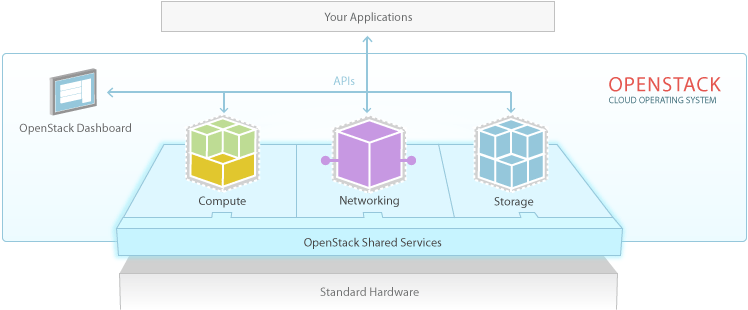
The following image is particularly indicative of OpenStack's purposes: it shows how the framework of the platform consists of three large functionalities (compute, network and storage), managed overall by a data center and ready to interact with the user through dashboards (a panel accessible via browser) or appropriate programming APIs. On the official website of the project you can find a considerably more detailed version, which shows the complexity of the platform.
The most important modules of Openstack are:
The present guide is structured in the following sections: