This document states workflows to develop and deploy IOC on a EPIK8S infrastructure.
Install docker engine for mac/windows https://www.docker.com/products/docker-desktop/
For debian:
apt-get install docker-io
Every IOC/application MUST have a GIT repository associated. A project must be created under https://baltig.infn.it/lnf-da-control or a different group like for instance:
https://baltig.infn.it/infn-epics
https://baltig.infn.it/epics-containers
Pay attention to not set the project private otherwise will not be possible to load it into the EPIK8S.
It's highly suggested to use https://code.visualstudio.com/ to handle the project.
It's also recommended to use a container for development to decouple development of the application from the platform where the application is developed.
It's really simple to use a container please read this guide: https://code.visualstudio.com/docs/devcontainers/containers
Depending on the target beamline (i.e. sparc environ EPIK8s Sparc):
For this kind of IOC it's recommended to use the docker image: baltig.infn.it:4567/epics-containers/epics-py-base since it contains the required packages and will be also the image that will be used to run this kind of softioc.
Create .devcontainer directory into your vscode workspace and create a devcontainer.json like the following:
// For format details, see https://containers.dev/implementors/json_reference/
{
    "name": "python container",
    "image": "baltig.infn.it:4567/epics-containers/epics-py-base",
    "remoteEnv": {
        // allows X11 apps to run inside the container
        "DISPLAY": "${localEnv:DISPLAY}",
        // provides a name for epics-containers to use in bash prompt etc.
        "EC_PROJECT": "${localWorkspaceFolderBasename}"
    },
    "features": {

    },
    // IMPORTANT for this devcontainer to work with docker EC_REMOTE_USER must be
    // set to vscode. For podman it should be left blank.
    "remoteUser": "${localEnv:EC_REMOTE_USER}",
    "customizations": {
        "vscode": {
            // Add the IDs of extensions you want installed when the container is created.
             "extensions": [
                "ms-python.python",
                "ms-python.vscode-pylance",
                "tamasfe.even-better-toml",
                "redhat.vscode-yaml",
                "ryanluker.vscode-coverage-gutters",
                "epicsdeb.vscode-epics",
                "ms-python.black-formatter"
            ]
        }
    },
    // Make sure the files we are mapping into the container exist on the host
    // You can place any other outside of the container before-launch commands here
    //"initializeCommand": "bash .devcontainer/initializeCommand ${devcontainerId}",
    // Hooks the global .bashprofile_dev_container but also can add any other commands
    // to run in the container at creation in here
    //"postCreateCommand": "bash .devcontainer/postCreateCommand ${devcontainerId}",
	// forward ports to clients
     "appPort": [5064,"5064:5064/udp","5065:5065/udp"],

    "runArgs": [
        // Allow the container to access the host X11 display and EPICS CA
        //"--net=host",
        // Make sure SELinux does not disable with access to host filesystems like tmp
        "--security-opt=label=disable"
    ],
    "workspaceMount": "source=${localWorkspaceFolder},target=/app/${localWorkspaceFolderBasename},type=bind",
    "workspaceFolder": "/app/${localWorkspaceFolderBasename}",
    "mounts": [
        // Mount some useful local files from the user's home directory
        // By mounting the parent of the workspace we can work on multiple peer projects
        "source=${localWorkspaceFolder}/../,target=/repos,type=bind",
        // this provides eternal bash history in and out of the container
        "source=${localEnv:HOME}/.bash_eternal_history,target=/root/.bash_eternal_history,type=bind",
        // this bashrc hooks up the .bashrc_dev_container in the following mount
        "source=${localWorkspaceFolder}/.devcontainer/.bashrc,target=/root/.bashrc,type=bind",
        // provides a place for you to put your shell customizations for all your dev containers
        "source=${localEnv:HOME}/.bashrc_dev_container,target=/root/.bashrc_dev_container,type=bind",
        // provides a place to install any packages you want to have across all your dev containers
        "source=${localEnv:HOME}/.bashprofile_dev_container,target=/root/.bashprofile_dev_container,type=bind",
        // provides the same command line editing experience as your host
        "source=${localEnv:HOME}/.inputrc,target=/root/.inputrc,type=bind"
    ]
} |
A fully functional example:
https://baltig.infn.it/infn-epics/py-ioc-collector
To test the container connection:
docker run -it baltig.infn.it:4567/epics-containers/epics-py-base bash

epics@d916ac2d3987:~$ export EPICS_CA_ADDR_LIST=rdsparcpitaia001.lnf.infn.it ## list of IOCs or gateway
epics@d916ac2d3987:~$ python
Python 3.10.12 (main, Nov 20 2023, 15:14:05) [GCC 11.4.0] on linux
Type "help", "copyright", "credits" or "license" for more information.
>>> import epics
>>> epics.caget("SR00RPA01:DVDR")
'Redpitaya' |
SOFT IOC Development SoftIOC in a Linux-like environment
A docker image that can be used as epics7 for development is:
ghcr.io/infn-epics/infn-epics-ioc-linux-developer:latest
It contains several support modules used in deployment.
For instance to start a shell and mount the current directory '.' to /mnt :
The example here below initialize a directory with a standard ioc/support tree:
docker run -p 5064:5064/udp -p 5064:5064/tcp -p 5065:5065/udp -p 5065:5065/tcp -v .:/mnt -it ghcr.io/infn-epics/infn-epics-ioc-linux-developer:latest bash ## docker shell cd /mnt ## go in the . directory that is mounted mkdir mynewiocsample cd mynewuicsample makeBaseApp.pl -t example mynewiocsample make |
It use the EPICS scripts makeBaseApp.pl to create a valid ioc tree directory tree.
If you have an account on github (strongly suggested), you can use a predefined github template to create a new git project from template: https://github.com/infn-epics/epics-devcontainer-template
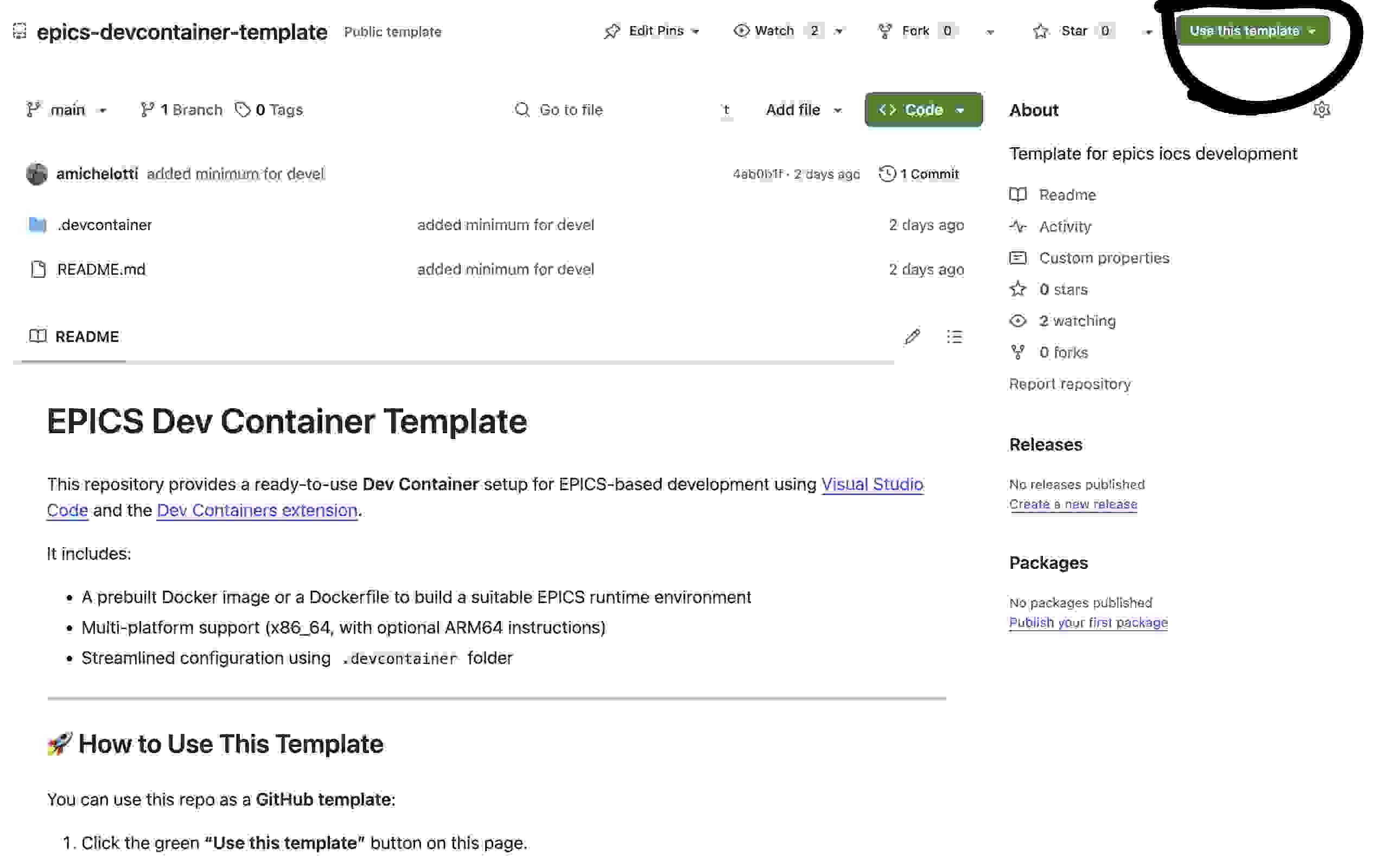
Otherwise:
Create .devcontainer directory into your vscode workspace and create a devcontainer.json like the following:
// For format details, see https://containers.dev/implementors/json_reference/
{
    "name": "Native IOC development container",
    "image": "ghcr.io/infn-epics/infn-epics-ioc-linux-developer:latest",
    "remoteEnv": {
        // allows X11 apps to run inside the container
        "DISPLAY": "${localEnv:DISPLAY}",
        // provides a name for epics-containers to use in bash prompt etc.
        "EC_PROJECT": "${localWorkspaceFolderBasename}"
    },
    "features": {

    },
    // IMPORTANT for this devcontainer to work with docker EC_REMOTE_USER must be
    // set to vscode. For podman it should be left blank.
    "remoteUser": "${localEnv:EC_REMOTE_USER}",
    "customizations": {
        "vscode": {
            // Add the IDs of extensions you want installed when the container is created.
             "extensions": [
                "ms-python.python",
                "ms-python.vscode-pylance",
                "tamasfe.even-better-toml",
                "redhat.vscode-yaml",
                "ryanluker.vscode-coverage-gutters",
                "epicsdeb.vscode-epics",
                "ms-python.black-formatter"
            ]
        }
    },
    // Make sure the files we are mapping into the container exist on the host
    // You can place any other outside of the container before-launch commands here
    //"initializeCommand": "bash .devcontainer/initializeCommand ${devcontainerId}",
    // Hooks the global .bashprofile_dev_container but also can add any other commands
    // to run in the container at creation in here
    //"postCreateCommand": "bash .devcontainer/postCreateCommand ${devcontainerId}",
	// forward ports to clients
     "appPort": [5064,"5064:5064/udp","5065:5065/udp"],

    "runArgs": [
        // Allow the container to access the host X11 display and EPICS CA
        //"--net=host",
        // Make sure SELinux does not disable with access to host filesystems like tmp
        "--security-opt=label=disable"
    ],
    "workspaceMount": "source=${localWorkspaceFolder},target=/app/${localWorkspaceFolderBasename},type=bind",
    "workspaceFolder": "/app/${localWorkspaceFolderBasename}",
    "mounts": [
        // Mount some useful local files from the user's home directory
        // By mounting the parent of the workspace we can work on multiple peer projects
        "source=${localWorkspaceFolder}/../,target=/repos,type=bind",


    ]
} |
Gigavision cameras that support GIGE protocol can be acquired by ADAravis support that is already included in production/development infn-epics-ioc container.
NOTE: this container must be launched with the --network=host to access GIGE cameras.
Example development the arv-tool command inside the container can be used to explore cameras that can be accessed:
docker run --network=host -v .:/epics/ioc/config -it ghcr.io/infn-epics/infn-epics-ioc-linux-developer:latest bash .. root@chaost-camera01:/epics/generic-source/ioc/config# arv-tool-0.8 Basler-a2A1920-51gmBAS-40426579 (192.168.115.49) Basler-a2A2600-20gmBAS-40437925 (192.168.115.48) Basler-scA640-70gm-24159532 (192.168.115.50) |
The configuration and pipelining of plugin can be very difficult and error prone, so the IBEK + templating support is highly recommended IBEK.
Create a directory <test> and create a camera_template.j2 file like that:
# yaml-language-server: $schema=../schemas/ibek.support.schema.json
ioc_name: {{name}}
description: Camera SIM model with plugins

entities:
  {%- if devtype == "camerasim" %}
  - type: ADSimDetector.simDetector
  {% else %}
  - type: ADAravis.aravisCamera
    ID: {{CAMERA_ID}}
    CLASS: {{CAMERA_CLASS}}
  {% endif %}
    PORT: {{iocroot}}
    P: "{{iocprefix}}:"
    R: "{{iocroot}}:"


  - type: ADCore.NDROI
    PORT: {{iocroot}}.ROI1
    NDARRAY_PORT: {{iocroot}}
    P: "{{iocprefix}}:{{iocroot}}"
    R: ":Roi1:"
    ENABLED: 1

  - type: ADCore.NDProcess
    PORT: {{iocroot}}.PROC
    P: "{{iocprefix}}:{{iocroot}}"
    R: ":Proc1:"
    NDARRAY_PORT: {{iocroot}}.ROI1
    ENABLED: 1

  - type: ADCore.NDOverlay
    PORT: {{iocroot}}.OVERLAY1
    NDARRAY_PORT: {{iocroot}}
    P: "{{iocprefix}}:{{iocroot}}"
    R: ":Overlay1:"
    NAME: "Reference"
    NOverlays: 8
    SHAPE: "3"
    XPOS: ""
    YPOS: ""
    XCENT: ""
    YCENT: ""
    XSIZE: ""
    YSIZE: ""
    XWIDTH: ""
    YWIDTH: ""
    O: "1:"

  # Want to have also high throuput PVA protocol
  - type: ADCore.NDPvaPlugin
    PORT: {{iocroot}}.PVA
    PVNAME: "{{iocprefix}}:{{iocroot}}:PVA:OUTPUT"
    P: "{{iocprefix}}:{{iocroot}}"
    R: ":Pva1:"
    NDARRAY_PORT: {{iocroot}}
    ENABLED: 1

  - type: ADCore.NDPvaPlugin
    PORT: {{iocroot}}.PVA2
    PVNAME: "{{iocprefix}}:{{iocroot}}:PROC:OUTPUT"
    P: "{{iocprefix}}:{{iocroot}}"
    R: ":Proc1:Pva1:"
    NDARRAY_PORT: {{iocroot}}.PROC
    ENABLED: 1


  - type: ADCore.NDPvaPlugin
    PORT: {{iocroot}}.PVA3
    PVNAME: "{{iocprefix}}:{{iocroot}}:ROI1:OUTPUT"
    P: "{{iocprefix}}:{{iocroot}}"
    R: ":Roi1:Pva1:"
    NDARRAY_PORT: {{iocroot}}.ROI1
    ENABLED: 1


  - type: ADCore.NDStdArrays
    P: "{{iocprefix}}:{{iocroot}}"
    R: ":image1:"
    PORT: {{iocroot}}.NTD
    NDARRAY_PORT: {{iocroot}}
    TYPE: {{CAMERA_TYPE}}
    FTVL: {{CAMERA_FTVL}}
    NELEMENTS: {{CAMERA_ELEMS}}
    ENABLED: 1


  - type: ADCore.NDPvaPlugin
    PORT: {{iocroot}}.PVA4
    PVNAME: "{{iocprefix}}:{{iocroot}}:OVERLAY1:OUTPUT"
    P: "{{iocprefix}}:{{iocroot}}"
    R: ":Overlay1:Pva1:"
    NDARRAY_PORT: {{iocroot}}.OVERLAY1
    ENABLED: 1

  - type: ADCore.NDStdArrays
    P: "{{iocprefix}}:{{iocroot}}"
    R: ":image2:"
    PORT: {{iocroot}}.NTD2
    NDARRAY_PORT: {{iocroot}}.PROC
    TYPE: {{CAMERA_TYPE}}
    FTVL: {{CAMERA_FTVL}}
    NELEMENTS: {{CAMERA_ELEMS}}
    ENABLED: 1

  - type: ADCore.NDStats
    PORT: {{iocroot}}.STATS
    NDARRAY_PORT: {{iocroot}}
    HIST_SIZE: 50
    P: "{{iocprefix}}:{{iocroot}}"
    R: ":Stats1:"
    XSIZE: {{CAMERA_STATS_XSIZE}}
    YSIZE: {{CAMERA_STATS_YSIZE}}
    ENABLED: 1

  - type: ADCore.NDStats
    PORT: {{iocroot}}.STATS2
    NDARRAY_PORT: {{iocroot}}.PROC
    HIST_SIZE: 50
    P: "{{iocprefix}}:{{iocroot}}"
    R: ":Proc1:Stats1:"
    XSIZE: {{CAMERA_STATS_XSIZE}}
    YSIZE: {{CAMERA_STATS_YSIZE}}
    ENABLED: 1

  - type: ADCore.NDStats
    PORT: {{iocroot}}.STATS3
    NDARRAY_PORT: {{iocroot}}.ROI1
    HIST_SIZE: 50
    P: "{{iocprefix}}:{{iocroot}}"
    R: ":Roi1:Stats1:"
    XSIZE: {{CAMERA_STATS_XSIZE}}
    YSIZE: {{CAMERA_STATS_YSIZE}}
    ENABLED: 1


  - type: ADCore.NDFileTIFF
    PORT: {{iocroot}}.TIFF
    NDARRAY_PORT: {{iocroot}}
    P: "{{iocprefix}}:{{iocroot}}"
    R: ":TIFF1:"
    ENABLED: 1

  - type: ADCore.NDFileTIFF
    PORT: {{iocroot}}.TIFF2
    NDARRAY_PORT: {{iocroot}}.PROC
    P: "{{iocprefix}}:{{iocroot}}"
    R: ":Proc1:TIFF1:"
    ENABLED: 1

  - type: ADCore.NDFileTIFF
    PORT: {{iocroot}}.TIFF3
    NDARRAY_PORT: {{iocroot}}.ROI1
    P: "{{iocprefix}}:{{iocroot}}"
    R: ":Roi1:TIFF1:"
    ENABLED: 1

  - type: ADCore.NDFileTIFF
    PORT: {{iocroot}}.TIFF4
    NDARRAY_PORT: {{iocroot}}.OVERLAY1
    P: "{{iocprefix}}:{{iocroot}}"
    R: ":Overlay1:TIFF1:"
    ENABLED: 1

  - type: epics.PostStartupCommand
    command: dbl              ## dumps PV NAMES

  - type: epics.PostStartupCommand
    command: |
      dbl("*") > {{data_config}}/pvlist.txt
      dbpf("{{iocprefix}}:{{iocroot}}:TIFF1:FilePath", "{{data_dir}}")
      dbpf("{{iocprefix}}:{{iocroot}}:TIFF1:FileWriteMode",2)
      dbpf("{{iocprefix}}:{{iocroot}}:TIFF1:FileName","camera")
      dbpf("{{iocprefix}}:{{iocroot}}:TIFF1:AutoIncrement",1)

      dbpf("{{iocprefix}}:{{iocroot}}:TIFF1:FileTemplate","%s%s_%3.3d.tiff")
      dbpf("{{iocprefix}}:{{iocroot}}:Proc1:TIFF1:FilePath", "{{data_dir}}")
      dbpf("{{iocprefix}}:{{iocroot}}:Proc1:TIFF1:FileWriteMode",2)
      dbpf("{{iocprefix}}:{{iocroot}}:Proc1:TIFF1:FileName","{{iocroot}}")
      dbpf("{{iocprefix}}:{{iocroot}}:Proc1:TIFF1:AutoIncrement",1)
      dbpf("{{iocprefix}}:{{iocroot}}:Proc1:TIFF1:FileTemplate","%s%s_proc_%3.3d.tiff")

      dbpf("{{iocprefix}}:{{iocroot}}:Proc1:TIFF:FilePath", "{{data_dir}}")
      dbpf("{{iocprefix}}:{{iocroot}}:Proc1:TIFF:FileWriteMode",2)
      dbpf("{{iocprefix}}:{{iocroot}}:Proc1:TIFF:FileName","{{iocroot}}")
      dbpf("{{iocprefix}}:{{iocroot}}:Proc1:TIFF:AutoIncrement",1)
      dbpf("{{iocprefix}}:{{iocroot}}:Proc1:TIFF:FileTemplate","%s%s_proc_%3.3d.tiff")

      dbpf("{{iocprefix}}:{{iocroot}}:Roi1:TIFF1:FilePath", "{{data_dir}}")
      dbpf("{{iocprefix}}:{{iocroot}}:Roi1:TIFF1:FileWriteMode",2)
      dbpf("{{iocprefix}}:{{iocroot}}:Roi1:TIFF1:FileName","{{iocroot}}")
      dbpf("{{iocprefix}}:{{iocroot}}:Roi1:TIFF1:AutoIncrement",1)
      dbpf("{{iocprefix}}:{{iocroot}}:Roi1:TIFF1:FileTemplate","%s%s_roi_%3.3d.tiff")
      dbpf("{{iocprefix}}:{{iocroot}}:Overlay1:TIFF1:FilePath", "{{data_dir}}")
      dbpf("{{iocprefix}}:{{iocroot}}:Overlay1:TIFF1:FileWriteMode",2)
      dbpf("{{iocprefix}}:{{iocroot}}:Overlay1:TIFF1:FileTemplate","%s%s_overlay_%3.3d.tiff")
      dbpf("{{iocprefix}}:{{iocroot}}:Overlay1:TIFF1:FileName","{{iocroot}}")
      dbpf("{{iocprefix}}:{{iocroot}}:Overlay1:EnableCallbacks","1")
      {%- for param in iocinit %}
        dbpf("{{iocprefix}}:{{iocroot}}:{{param.name}}","{{param.value}}")
      {%- endfor %}

  - type: epics.EpicsCaMaxArrayBytes
max_bytes: 10000000 |
And a camerainit.yml that produce the ibek yaml for the given camera:
name: "SCOUT640"
asset: "https://confluence.infn.it/x/nYD8DQ"
charturl: 'https://baltig.infn.it/epics-containers/ioc-launcher-chart.git'
host: "192.168.197.24"
user: "root"
iocdir: "camera"
ca_server_port: 5264
pva_server_port: 5275
docker:
  enable: true
  image: baltig.infn.it:4567/epics-containers/infn-epics-ioc:latest
devtype: camera
devgroup: diag
iocprefix: "EUAPS:CAM"
iocroot: "SCOUT64"
autosync: false ## restart automatically on changes
opi:
  url: https://baltig.infn.it/infn-epics/camera-opi.git
  main: Camera_Main.bob
  macro:
    - name: "DEVICE"
      value: EUAPS:CAM
    - name: "CAM"
      value: "SCOUT64"

CAMERA_ID: "Basler-scA640-70gm-24159532"
CAMERA_CLASS: "Basler-scA640-70gm"
CAMERA_TYPE: "Int8"
CAMERA_FTVL: "USHORT"
CAMERA_ELEMS: 5616000
CAMERA_STATS_XSIZE: 1024
CAMERA_STATS_YSIZE: 768 |
The application jnjrender (pip install jnjrender) will render a valid ibek yaml camera_template.yaml
jnjrender camera_template.j2 camerainit.yml --output camera_template.yaml |
Now launch the docker mounting the directory that contains the camera_template.yaml in /epics/ioc/config
docker run --network=host -v .:/epics/ioc/config -it baltig.infn.it:4567/epics-containers/infn-epics-ioc |
Once your IOC/application named 'mynewioc' is tested and ready to be published on the target EPIK8S.
Identify your target EPIK8S information page (i.e EPIK8s Sparc ) retrieving "GIT Control Source" URL, clone it:
git clone https://baltig.infn.it/lnf-da-control/epik8-<BEAMLINE>.git --recurse-submodules |
or update a pre-existing one:
git pull --recurse-submodules ## to update remote changes |
you should have a directory like this:
├── README.md ├── config │ ├── applications │ │ ├── flame-state-import │ │ └── icpdastemp01 │ ├── iocs │ │ ├── mrf01 │ │ ├── pitaya │ │ ├── temp01 │ │ └── mynewioc <-- add here your folder or git subproject for configuration │ └── services │ └── cagateway ├── deploy │ ├── Chart.yaml │ ├── templates │ │ └── epik8.yaml │ └── values.yaml <-- add here your IOC to deploy ├─ ... |
Suppose your iocname is mynewioc you should create a folder with the same name. This folder should contain a:
In case mynewioc is a soft IOC this directory should also contain the git submodule that point to your application git repository.
If your mynewioc is a softioc you should have a repository for it. So in the EPIK8S folder config/iocs/mynewioc you must add your repository as submodule:
cd <EPIK8Sfolder/config/iocs> git pull --recurse-submodules ## to update remote changes git submodule update --init ## to update eventually new submodules mkdir mynewioc git add mynewioc cd mynewioc ## here add your new submodule git submodule add <your repository_URL> scripts # your softioc repository will be added as scripts git commit -m "your comment Add submodule <submodule_name>" git push origin <your remote branch i.e main/master> |
In your application repository create a bash file named start.sh (bash script) that will be used to start your application.
#!/bin/bash script_dir=$(dirname "$0") cd $script_dir echo "Starting $__IOC_NAME__ : $EPICS_CA_ADDR_LIST" python ./scripts/mynewioc <parameters> -c myconfig.json |
This script will launch ./scripts/mynewioc (remember scripts scripts is the folder name you gave to your submodule in the previous step) and will give some parameters and a configuration myconfig.json file that must be added to the mynewioc.
Once your configuration directory mynewioc is complete. We need to add to the main git repository.
cd <EPIK8Sfolder/config/iocs/mynewioc> chmod a+x start.sh # make start.sh executable git add start.sh myconfig.json scripts git commit -m "my comment" . git push origin |
This way we just added the information needed to start the ioc, but we still instruct ArgoCD to launch the IOC in the EPIK8S target infrastructure.
We should now add and entry into <EPIK8Sfolder/deploy/values.yaml>
We must distinguish IOC types, the configuration is slightly different if the IOC runs inside the cluster or outside.
You must find the iocs section in deploy/values.yaml and add your IOC:
name: "mynewioc"
      asset: "https://confluence.infn.it/x/nYD8DQ"
      charturl: 'https://baltig.infn.it/epics-containers/ioc-chart.git'
      image: baltig.infn.it:4567/epics-containers/epics-py-base
      iocprefix: "SPARC:ORBIT"
      start: "/epics/ioc/config/start.sh" ## if your mynewioc has a start.sh this line must be kept
      gitinit: true
|
This is the case of devices that have an IOC embedded. This case EPIK8S will transfer the configuration on the remote target and will start the IOC via ssh.
NOTE: the remote IOC must have sshd and an authorised key to perform ssh commands.
 - name: "mrf01"
      asset: "https://confluence.infn.it/x/nYD8DQ"
      charturl: 'https://baltig.infn.it/epics-containers/ioc-launcher-chart.git'
      iocname: "mrf01"
      iocprefix: "MRF01"
      host: "plsparcmrf001.lnf.infn.it"									## HOST
      user: "root"														## USER
      workdir: "/home/nat/progetti/mrfioc2/iocBoot/epik8s"				## WORKDIR (where transfer config/iocs/mrf01 configuration)
      exec: "start.sh"
|
It's recommended to test the deploy before commit changes to avoid putting not working deploy in ARGOCD that will block any other deploy.
To test a deploy, you need to have helm tool installed, then go into the deploy directory just where the values.yaml is. Then do the following command:
helm template --debug . |
Once your deploy configuration is ready you should commit.
cd <EPIK8Sfolder/> git commit -m "my comment" . git push origin |
ArgoCD after few minutes will update the cluster.
The status should be visible on https://argocd-server-argocd.apps.okd-datest.lnf.infn.it/applications
If you only wants to updated an existing IOC, after it has been modified in the linked repository:
cd /<your git directory>/epik8-<beamline name> ## for example epik8-sparc git pull --recurse-submodules ## to update remote changes git submodule update --init ## to update eventually new submodules cd <config/iocs/<ioc_name>/scripts> git pull ## updates to remote changes cd .. git add ./scripts/ git commit -m "updated IOC <ioc_name>" git push origin |
To make the changes effective in the running IOC, you have to restart the related process in ArgoCD.
If you want your new IOC be visible to all EPICS CA clients you should restart ca-gateway service via ArgoCD. This could bring few seconds of services interruption.
Install Phoebus: Phoebus.
If you want to develop the OPI for your IOC however each K8S ECS installation has in its GIT Control Source project a directory opi (that is a git subproject with other subproject) that contain a Launcher.bob and a start.sh, this setup is intended to start the main control interface of a given beamline.
If you are developing an gui interface that must be integrated in the control a OPI Development Workflow must be followed.