...
Create a GIT repository
Every IOC/application MUST have a GIT repository associated. A project must be created under https://baltig.infn.it/lnf-da-control or a different group like for instance:
https://baltig.infn.it/infn-epics
httpshtps://baltig.infn.it/epics-containers
Pay attention to not set the project private otherwise will not be possible to load it into the EPIK8S.
...
Create .devcontainer directory into your vscode workspace and create a devcontainer.json like the following:
| Code Block | ||||
|---|---|---|---|---|
| ||||
// For format details, see https://containers.dev/implementors/json_reference/
{
    "name": "python container",
    "image": "baltig.infn.it:4567/epics-containers/epics-py-base",
    "remoteEnv": {
        // allows X11 apps to run inside the container
        "DISPLAY": "${localEnv:DISPLAY}",
        // provides a name for epics-containers to use in bash prompt etc.
        "EC_PROJECT": "${localWorkspaceFolderBasename}"
    },
    "features": {

    },
    // IMPORTANT for this devcontainer to work with docker EC_REMOTE_USER must be
    // set to vscode. For podman it should be left blank.
    "remoteUser": "${localEnv:EC_REMOTE_USER}",
    "customizations": {
        "vscode": {
            // Add the IDs of extensions you want installed when the container is created.
             "extensions": [
                "ms-python.python",
                "ms-python.vscode-pylance",
                "tamasfe.even-better-toml",
                "redhat.vscode-yaml",
                "ryanluker.vscode-coverage-gutters",
                "epicsdeb.vscode-epics",
                "ms-python.black-formatter"
            ]
        }
    },
    // Make sure the files we are mapping into the container exist on the host
    // You can place any other outside of the container before-launch commands here
    //"initializeCommand": "bash .devcontainer/initializeCommand ${devcontainerId}",
    // Hooks the global .bashprofile_dev_container but also can add any other commands
    // to run in the container at creation in here
    //"postCreateCommand": "bash .devcontainer/postCreateCommand ${devcontainerId}",
	// forward ports to clients
     "appPort": [5064,"5064:5064/udp","5065:5065/udp"],

    "runArgs": [
        // Allow the container to access the host X11 display and EPICS CA
        //"--net=host",
        // Make sure SELinux does not disable with access to host filesystems like tmp
        "--security-opt=label=disable"
    ],
    "workspaceMount": "source=${localWorkspaceFolder},target=/app/${localWorkspaceFolderBasename},type=bind",
    "workspaceFolder": "/app/${localWorkspaceFolderBasename}",
    "mounts": [
        // Mount some useful local files from the user's home directory
        // By mounting the parent of the workspace we can work on multiple peer projects
        "source=${localWorkspaceFolder}/../,target=/repos,type=bind",
        // this provides eternal bash history in and out of the container
        "source=${localEnv:HOME}/.bash_eternal_history,target=/root/.bash_eternal_history,type=bind",
        // this bashrc hooks up the .bashrc_dev_container in the following mount
        "source=${localWorkspaceFolder}/.devcontainer/.bashrc,target=/root/.bashrc,type=bind",
        // provides a place for you to put your shell customizations for all your dev containers
        "source=${localEnv:HOME}/.bashrc_dev_container,target=/root/.bashrc_dev_container,type=bind",
        // provides a place to install any packages you want to have across all your dev containers
        "source=${localEnv:HOME}/.bashprofile_dev_container,target=/root/.bashprofile_dev_container,type=bind",
        // provides the same command line editing experience as your host
        "source=${localEnv:HOME}/.inputrc,target=/root/.inputrc,type=bind"
    ]
} |
...
SOFT IOC Development SoftIOC in a Linux-like environment
EPICS
...
C/C++ IOC Development
A docker image that can be used as epics7 for development is:
baltigghcr.infn.it:4567/epics-containersio/infn-epics/infn-epics-ioc:devel-developer
It contains several support modules used in deployment.
Simple command line interaction
For So for instance to start a shell and mount the current directory '.' to /mnt :
The The example here below initialize a directory with a standard ioc/support tree:
| Code Block | ||||
|---|---|---|---|---|
| ||||
docker run -p 5064:5064/udp -p 5064:5064/tcp -p 5065:5065/udp -p 5065:5065/tcp -v .:/mnt -it baltigghcr.infn.it:4567/epics-containersio/infn-epics/infn-epics-ioc-linux-developer:devellatest bash ## docker shell cd /mnt ## go in the . directory that is mounted mkdir mynewiocsample cd mynewuicsample makeBaseApp.pl -t example mynewiocsample make |
Setup a target container
Create .devcontainer directory into your vscode workspace and create a devcontainer.json like the following:
 # create DB and support
makeBaseApp.pl -i -t example mynewiocsample  mynewiocsample # create iocboot directory ## as appname use mynewiocsample

make
cd mynewiocsample/iocboot/mynewiocsample # st.cmd
chmod +x ./st.cmd ## to make it executable
./st.cmd # start the ioc and load example DB |
It use the EPICS scripts makeBaseApp.pl to create a valid ioc tree directory tree.
Setup a target container
If you have an account on github (strongly suggested), you can use a predefined github template to create a new git project from template: https://github.com/infn-epics/epics-devcontainer-template
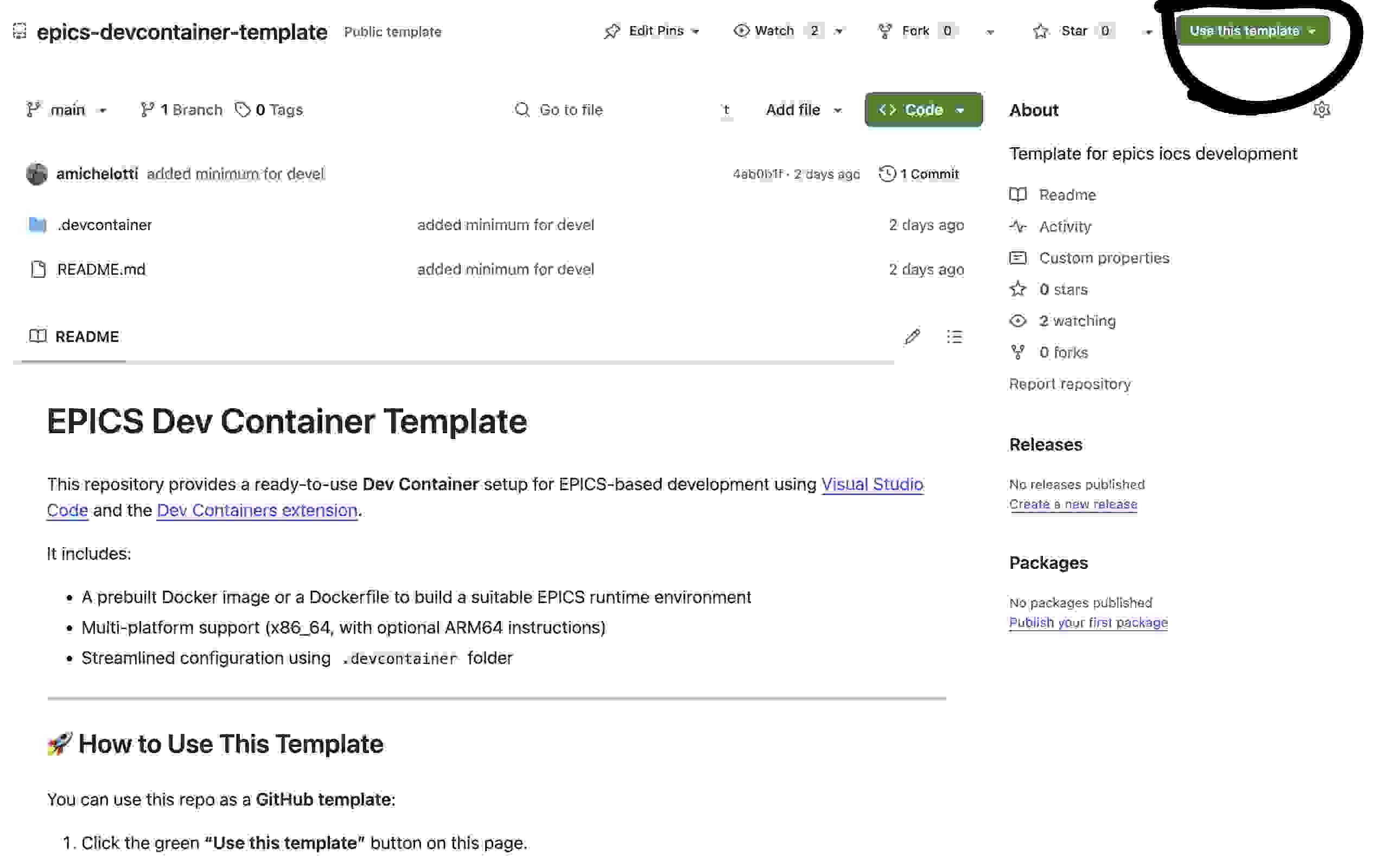
Otherwise:
Create .devcontainer directory into your vscode workspace and create a devcontainer.json like the following:
| Code Block | ||
|---|---|---|
| ||
// For format details, see https://containers.dev/implementors/json_reference/
{
    "name": "Native IOC development container",
"image": "ghcr.io/infn-epics/infn-epics-ioc-linux-developer:latest" | ||
| Code Block | ||
| ||
// For format details, see https://containers.dev/implementors/json_reference/ { "name": "Native IOC development container", "image": "baltig.infn.it:4567/epics-containers/infn-epics-ioc:devel", "remoteEnv": { // allows X11 apps to run inside the container "DISPLAY": "${localEnv:DISPLAY}", // provides a name for epics-containers to use in bash prompt etc. "EC_PROJECT": "${localWorkspaceFolderBasename}" }, "featuresremoteEnv": { // allows X11 }, // IMPORTANT for this devcontainer to work with docker EC_REMOTE_USER must be apps to run inside the container "DISPLAY": "${localEnv:DISPLAY}", // provides seta toname vscode. For podman it should be left blank. for epics-containers to use in bash prompt etc. "remoteUserEC_PROJECT": "${localEnv:EC_REMOTE_USERlocalWorkspaceFolderBasename}" }, "customizationsfeatures": { "vscode": { }, // IMPORTANT for this //devcontainer Add the to work with docker EC_REMOTE_USER must be // set to vscode. For podman it should be left blank. "remoteUser": "${localEnv:EC_REMOTE_USER}", "customizations": { "vscode": { // Add the IDs of extensions you want installed when the container is created. "extensions": [ "ms-python.python", "ms-python.vscode-pylance", "tamasfe.even-better-toml", "redhat.vscode-yaml", "ryanluker.vscode-coverage-gutters", "epicsdeb.vscode-epics", "ms-python.black-formatter" ] } }, // Make sure the files we are mapping into the container exist on the host // You can place any other outside of the container before-launch commands here //"initializeCommand": "bash .devcontainer/initializeCommand ${devcontainerId}", // Hooks the global .bashprofile_dev_container but also can add any other commands // to run in the container at creation in here //"postCreateCommand": "bash .devcontainer/postCreateCommand ${devcontainerId}", // forward ports to clients "appPort": [5064,"5064:5064/udp","5065:5065/udp"], "runArgs": [ // Allow the container to access the host X11 display and EPICS CA //"--net=host", // Make sure SELinux does not disable with access to host filesystems like tmp "--security-opt=label=disable" ], "workspaceMount": "source=${localWorkspaceFolder},target=/app/${localWorkspaceFolderBasename},type=bind", "workspaceFolder": "/app/${localWorkspaceFolderBasename}", "mounts": [ // Mount some useful local files from the user's home directory // By mounting the parent of the workspace we can work on multiple peer projects "source=${localWorkspaceFolder}/../,target=/repos,type=bind", ] } |
GIGE Camera
Gigavision cameras that support GIGE protocol can be acquired by ADAravis support that is already included in production/development infn-epics-ioc container.
NOTE: this container must be launched with the --network=host to access GIGE cameras.
Devel example
Example development the arv-tool command inside the container can be used to explore cameras that can be accessed:
| Code Block | ||||
|---|---|---|---|---|
| ||||
docker run --network=host -v .:/epics/ioc/config -it baltig.infn.it:4567/epics-containers/infn-epics-ioc:devel bash
..

root@chaost-camera01:/epics/generic-source/ioc/config# arv-tool-0.8
Basler-a2A1920-51gmBAS-40426579 (192.168.115.49)
Basler-a2A2600-20gmBAS-40437925 (192.168.115.48)
Basler-scA640-70gm-24159532 (192.168.115.50) |
Production example
The configuration and pipelining of plugin can be very difficult and error prone, so the IBEK + templating support is highly recommended IBEK.
Create a directory <test> and create a camera_template.j2 file like that:
camera template
REMOTE POD DEVELOPMENT (NEW)
It may be possible that some IOC access a network or HW that is not available locally.
The administrator could have created development pods that run exactly where they should run, this pods have all the environment and the minimum packages to develop epics and softioc applications.
These pods are accessible via ssh and specific ports, for these pods it is possible to setup VSCODE remote development via ssh.
These pods runs in the cluster so they can be view by gateways and other tools.
Allocation of a new pod for development
The allocation of a new pod for development is straightforward, it needs to add an entry in the EPIK8s beamline yaml configuration (deploy/values.yaml) see EPIK8s Beamline.
In the following example are instantiated different developments pods:
- development-andrea, it is constrained to run on the nodes that may access sparc-magnets network
- development-alessandro, it is constrained to run on the nodes that may access sparc-cams network
- development-gpu it is contrained to run on nodes that have a GPU
- development-generic it's not constrained and may run everywhere
To access a development pod simply use ssh dante@<one machine cluster address i.e 10.10.6.18> -p <ssh_nodeport>.
Entry in values.yaml
| Code Block | ||||
|---|---|---|---|---|
| ||||
- name: "development-andrea"
      image: "ghcr.io/infn-epics/infn-epics-ioc-developer"
      charturl: 'https://baltig.infn.it/epics-containers/ioc-chart.git'
      autosync: false ## restart automatically on changes
      devtype: development
      networks:
        - name: "control"
          annotation: "sparc-magnets"
      ssh_nodeport: 30022
      securityContext:
        runAsUser: 0
        runAsGroup: 0

    - name: "development-alessandro"
      image: "ghcr.io/infn-epics/infn-epics-ioc-developer"
      charturl: 'https://baltig.infn.it/epics-containers/ioc-chart.git'
      autosync: false ## restart automatically on changes
      devtype: development
      networks:
        - name: "control"
          annotation: "sparc-cams"
      ssh_nodeport: 30023
      securityContext:
        runAsUser: 0
        runAsGroup: 0

	- name: "development-gpu"
      image: "ghcr.io/infn-epics/infn-epics-ioc-developer"
      charturl: 'https://baltig.infn.it/epics-containers/ioc-chart.git'
      autosync: false ## restart automatically on changes
      devtype: development
      runon:
        - name: "control"
          annotation: "gpu"
      ssh_nodeport: 30029
      securityContext:
        runAsUser: 0
        runAsGroup: 0

	- name: "development-generic"
      image: "ghcr.io/infn-epics/infn-epics-ioc-developer"
      charturl: 'https://baltig.infn.it/epics-containers/ioc-chart.git'
      autosync: false ## restart automatically on changes
      devtype: development

      ssh_nodeport: 30028
      securityContext:
        runAsUser: 0
runAsGroup: 0 |
So for instance:
| Code Block | ||||
|---|---|---|---|---|
| ||||
ssh epics@10.10.6.18 -p 30022 ## will access pod development-andrea
ssh epics@10.10.6.18 -p 30023 ## will access pod development-alessandro
ssh epics@10.10.6.18 -p 30024 ## will access pod development-gpu |
ssh config client
It can be useful for VScode development to add a specific entry in .ssh/config, adding these lines it will be possible to connect just doing ssh epics@10.10.6.18 and passord
| Code Block | ||||
|---|---|---|---|---|
| ||||
Host 10.10.6.18
  HostName 10.10.6.18
  User epics
  Port 300xx ## replace with yours
  StrictHostKeyChecking no
  UserKnownHostsFile /dev/null
|
New IOC using Modbus support
You can use the predefined github template to create the new modbus IOC project for your ioc template: MODBUS TEMPLATE
Examples
New IOC using StreamDevice support
You can use the predefined github template to create the new streamdevice IOC project for your ioc template: STREAMDEVICE TEMPLATE
Examples
GIGE Camera
Gigavision cameras that support GIGE protocol can be acquired by ADAravis support that is already included in production/development infn-epics-ioc container.
NOTE: this container must be launched with the --network=host to access GIGE cameras.
Devel example
Example development the arv-tool command inside the container can be used to explore cameras that can be accessed:
| Code Block | ||||
|---|---|---|---|---|
| ||||
docker run --network=host -v .:/epics/ioc/config -it ghcr.io/infn-epics/infn-epics-ioc-linux-developer:latest bash
..

root@chaost-camera01:/epics/generic-source/ioc/config# arv-tool-0.8
Basler-a2A1920-51gmBAS-40426579 (192.168.115.49)
Basler-a2A2600-20gmBAS-40437925 (192.168.115.48)
Basler-scA640-70gm-24159532 (192.168.115.50) |
Production example
The configuration and pipelining of plugin can be very difficult and error prone, so the IBEK + templating support is highly recommended IBEK.
Create a directory <test> and create a camera_template.j2 file like that:
camera template
| Code Block | ||||
|---|---|---|---|---|
| ||||
# yaml-language-server: $schema=../schemas/ibek.support.schema.json
ioc_name: {{name}}
description: Camera SIM model with plugins

entities:
  {%- if devtype == "camerasim" %}
  - type: ADSimDetector.simDetector
  {% else %}
  - type: ADAravis.aravisCamera
    ID: {{CAMERA_ID}}
    CLASS: {{CAMERA_CLASS}}
  {% endif %}
PORT: {{iocroot}} | ||||
| Code Block | ||||
| ||||
# yaml-language-server: $schema=../schemas/ibek.support.schema.json ioc_name: {{name}} description: Camera SIM model with plugins entities: {%- if devtype == "camerasim" %} - type: ADSimDetector.simDetector {% else %} - type: ADAravis.aravisCamera ID: {{CAMERA_ID}} CLASS: {{CAMERA_CLASS}} {% endif %} PORT: {{iocroot}} P: "{{iocprefix}}:" R: "{{iocroot}}:" - type: ADCore.NDROI PORT: {{iocroot}}.ROI1 NDARRAY_PORT: {{iocroot}} P: "{{iocprefix}}:{{iocroot}}" R: ":Roi1:" ENABLED: 1 - type: ADCore.NDProcess PORT: {{iocroot}}.PROC P: "{{iocprefix}}:{{iocroot}}" R: ":Proc1:" NDARRAY_PORT: {{iocroot}}.ROI1 ENABLED: 1 - type: ADCore.NDOverlay PORT: {{iocroot}}.OVERLAY1 NDARRAY_PORT: {{iocroot}} P: "{{iocprefix}}:{{iocroot}}" R: ":Overlay1:" NAME: "Reference" NOverlays: 8 SHAPE: "3" XPOS: "" YPOS: "" XCENT: "" YCENT: "" XSIZE: "" YSIZE: "" XWIDTH: "" YWIDTH: "" O: "1:" # Want to have also high throuput PVA protocol - type: ADCore.NDPvaPlugin PORT: {{iocroot}}.PVA PVNAME: "{{iocprefix}}:{{iocroot}}:PVA:OUTPUT" P: "{{iocprefix}}:{{iocroot}}" R: ":Pva1:" NDARRAY_PORT: {{iocroot}} ENABLED: 1 - type: ADCore.NDPvaPlugin PORT: {{iocroot}}.PVA2 PVNAME: "{{iocprefix}}:{{iocroot}}:PROC:OUTPUT" P: "{{iocprefix}}:{{iocroot}}" R: ":Proc1:Pva1:" NDARRAY_PORT: {{iocroot}}.PROC ENABLED: 1 - type: ADCore.NDPvaPlugin PORT: {{iocroot}}.PVA3 PVNAME: "{{iocprefix}}:{{iocroot}}:ROI1:OUTPUT" P: "{{iocprefix}}:{{iocroot}}" R: ":Roi1:Pva1:" NDARRAY_PORT: {{iocroot}}.ROI1 ENABLED: 1 - type: ADCore.NDStdArrays P: "{{iocprefix}}:{{iocroot}}" R: ":image1:" PORT: {{iocroot}}.NTD NDARRAY_PORT: {{iocroot}} TYPE: {{CAMERA_TYPE}} FTVL: {{CAMERA_FTVL}} NELEMENTS: {{CAMERA_ELEMS}} ENABLED: 1 - type: ADCore.NDPvaPlugin PORT: {{iocroot}}.PVA4 PVNAME: "{{iocprefix}}:{{iocroot}}:OVERLAY1:OUTPUT" P: "{{iocprefix}}:{{iocroot}}" R: ":Overlay1:Pva1:" NDARRAY_PORT: {{iocroot}}.OVERLAY1 ENABLED: 1 - type: ADCore.NDStdArrays P: "{{iocprefix}}:{{iocroot}}" R: ":image2:" PORT: {{iocroot}}.NTD2 NDARRAY_PORT: {{iocroot}}.PROC TYPE: {{CAMERA_TYPE}} FTVL: {{CAMERA_FTVL}} NELEMENTS: {{CAMERA_ELEMS}} ENABLED: 1 - type: ADCore.NDStats PORT: {{iocroot}}.STATS NDARRAY_PORT: {{iocroot}} HIST_SIZE: 50 P: "{{iocprefix}}:{{iocroot}}" R: ":Stats1:" XSIZE: {{CAMERA_STATS_XSIZE}} YSIZE: {{CAMERA_STATS_YSIZE}} ENABLED: 1{{iocroot}}:" - type: ADCore.NDStatsNDROI PORT: {{iocroot}}.STATS2ROI1 NDARRAY_PORT: {{iocroot}}.PROC HIST_SIZE: 50 P: "{{iocprefix}}:{{iocroot}}" R: ":Proc1Roi1:Stats1:" XSIZE: {{CAMERA_STATS_XSIZE}} YSIZE: {{CAMERA_STATS_YSIZE}} ENABLED: 1 - type: ADCore.NDStatsNDProcess PORT: {{iocroot}}.STATS3PROC NDARRAY_PORTP: "{{iocprefix}}:{{iocroot}}.ROI1 HIST_SIZE: 50 P: "{{iocprefix}}:{{iocroot}}" R: ":Roi1:Stats1Proc1:" XSIZE: {{CAMERA_STATS_XSIZE}} YSIZENDARRAY_PORT: {{CAMERA_STATS_YSIZEiocroot}}.ROI1 ENABLED: 1 - type: ADCore.NDFileTIFFNDOverlay PORT: {{iocroot}}.TIFFOVERLAY1 NDARRAY_PORT: {{iocroot}} P: "{{iocprefix}}:{{iocroot}}" R: ":TIFF1Overlay1:" ENABLEDNAME: 1"Reference" - typeNOverlays: ADCore.NDFileTIFF8 PORTSHAPE: {{iocroot}}.TIFF2"3" NDARRAY_PORTXPOS: {{iocroot}}.PROC"" PYPOS: "{{iocprefix}}:{{iocroot}}" RXCENT: ":Proc1:TIFF1:" ENABLEDYCENT: 1"" - typeXSIZE: ADCore.NDFileTIFF"" PORTYSIZE: {{iocroot}}.TIFF3"" NDARRAY_PORTXWIDTH: {{iocroot}}.ROI1"" PYWIDTH: "{{iocprefix}}:{{iocroot}}" RO: ":Roi1:TIFF11:" # Want to have also high ENABLED: 1 throuput PVA protocol - type: ADCore.NDFileTIFFNDPvaPlugin PORT: {{iocroot}}.TIFF4PVA NDARRAY_PORTPVNAME: "{{iocprefix}}:{{iocroot}}.OVERLAY1:PVA:OUTPUT" P: "{{iocprefix}}:{{iocroot}}" R: ":Overlay1Pva1:TIFF1:" ENABLEDNDARRAY_PORT: 1 {{iocroot}} - typeENABLED: epics.PostStartupCommand command: dbl ## dumps PV NAMES 1 - type: epicsADCore.PostStartupCommand NDPvaPlugin command: | dbl("*") >PORT: {{data_configiocroot}}/pvlist.txtPVA2 PVNAME: dbpf("{{iocprefix}}:{{iocroot}}:TIFF1PROC:FilePath",OUTPUT" P: "{{data_diriocprefix}}"):{{iocroot}}" R: dbpf("{{iocprefix}}:":Proc1:Pva1:" NDARRAY_PORT: {{iocroot}}:TIFF1:FileWriteMode",2).PROC ENABLED: 1 - dbpf("{{iocprefix}}:type: ADCore.NDPvaPlugin PORT: {{iocroot}}:TIFF1:FileName","camera").PVA3 PVNAME: dbpf("{{iocprefix}}:{{iocroot}}:TIFF1ROI1:AutoIncrementOUTPUT",1) P: dbpf("{{iocprefix}}:{{iocroot}}:TIFF1:FileTemplate","%s%s_%3.3d.tiff")" R: ":Roi1:Pva1:" dbpf("{{iocprefix}}:{{NDARRAY_PORT: {{iocroot}}:Proc1:TIFF1:FilePath", "{{data_dir}}").ROI1 ENABLED: 1 - type: ADCore.NDStdArrays P: dbpf("{{iocprefix}}:{{iocroot}}:Proc1:TIFF1:FileWriteMode",2)" R: ":image1:" PORT: dbpf("{{iocprefixiocroot}}.NTD NDARRAY_PORT: {{iocroot}}:Proc1:TIFF1:FileName","{{iocroot}}") TYPE: {{CAMERA_TYPE}} FTVL: dbpf("{{iocprefixCAMERA_FTVL}} NELEMENTS: {{iocrootCAMERA_ELEMS}}:Proc1:TIFF1:AutoIncrement",1) ENABLED: 1 - type: ADCore.NDPvaPlugin PORT: {{iocroot}}.PVA4 PVNAME: dbpf("{{iocprefix}}:{{iocroot}}:Proc1:TIFF1:FileTemplate","%s%s_proc_%3.3d.tiff") OVERLAY1:OUTPUT" P: dbpf("{{iocprefix}}:{{iocroot}}:Proc1:TIFF:FilePath", "{{data_dir}}")" R: ":Overlay1:Pva1:" dbpf("{{iocprefix}}:NDARRAY_PORT: {{iocroot}}:Proc1:TIFF:FileWriteMode",2).OVERLAY1 ENABLED: 1 - type: ADCore.NDStdArrays P: dbpf("{{iocprefix}}:{{iocroot}}:Proc1:TIFF:FileName","" R: ":image2:" PORT: {{iocroot}}").NTD2 dbpf("NDARRAY_PORT: {{iocprefixiocroot}}.PROC TYPE: {{iocrootCAMERA_TYPE}}:Proc1:TIFF:AutoIncrement",1) FTVL: dbpf("{{iocprefixCAMERA_FTVL}} NELEMENTS: {{iocrootCAMERA_ELEMS}}:Proc1:TIFF:FileTemplate","%s%s_proc_%3.3d.tiff") dbpf("{{iocprefix}}:{{iocroot}}:Roi1:TIFF1:FilePath", "{{data_dir}}") dbpf( ENABLED: 1 - type: ADCore.NDStats PORT: {{iocroot}}.STATS NDARRAY_PORT: {{iocroot}} HIST_SIZE: 50 P: "{{iocprefix}}:{{iocroot}}:Roi1:TIFF1:FileWriteMode",2) R: dbpf("{{iocprefix}}:{{iocroot}}:Roi1:TIFF1:FileName","{{iocroot}}"):Stats1:" XSIZE: dbpf("{{iocprefixCAMERA_STATS_XSIZE}} YSIZE: {{iocrootCAMERA_STATS_YSIZE}}:Roi1:TIFF1:AutoIncrement",1) ENABLED: 1 - type: ADCore.NDStats dbpf("{{iocprefix}}:PORT: {{iocroot}}:Roi1:TIFF1:FileTemplate","%s%s_roi_%3.3d.tiff").STATS2 dbpf("{{iocprefix}}:{{iocroot}}:Overlay1:TIFF1:FilePath", "{{data_dir}}")NDARRAY_PORT: {{iocroot}}.PROC HIST_SIZE: 50 P: dbpf("{{iocprefix}}:{{iocroot}}:Overlay1:TIFF1:FileWriteMode",2)" R: ":Proc1:Stats1:" XSIZE: dbpf("{{iocprefixCAMERA_STATS_XSIZE}} YSIZE: {{iocroot}}:Overlay1:TIFF1:FileTemplate","%s%s_overlay_%3.3d.tiff") dbpf("{{iocprefix}}:{{iocroot}}:Overlay1:TIFF1:FileName","{{iocroot}}") dbpf("{{iocprefix}}:{{iocroot}}:Overlay1:EnableCallbacks","1") {%- for param in iocinit %} dbpf("{{iocprefix}}:{{iocroot}}:{{param.name}}","{{param.value}}") {%- endfor %} - type: epics.EpicsCaMaxArrayBytes max_bytes: 10000000 |
camera ibek specific rendering
And a camerainit.yml that produce the ibek yaml for the given camera:
| Code Block | ||||
|---|---|---|---|---|
| ||||
name: "SCOUT640"
asset: "https://confluence.infn.it/x/nYD8DQ"
charturl: 'https://baltig.infn.it/epics-containers/ioc-launcher-chart.git'
host: "192.168.197.24"
user: "root"
iocdir: "camera"
ca_server_port: 5264
pva_server_port: 5275
docker:
  enable: true
  image: baltig.infn.it:4567/epics-containers/infn-epics-ioc:latest
devtype: camera
devgroup: diag
iocprefix: "EUAPS:CAM"
iocroot: "SCOUT64"
autosync: false ## restart automatically on changes
opi:
  url: https://baltig.infn.it/infn-epics/camera-opi.git
  main: Camera_Main.bob
  macro:
    - name: "DEVICE"
      value: EUAPS:CAM
    - name: "CAM"
      value: "SCOUT64"

CAMERA_ID: "Basler-scA640-70gm-24159532"
CAMERA_CLASS: "Basler-scA640-70gm"
CAMERA_TYPE: "Int8"
CAMERA_FTVL: "USHORT"
CAMERA_ELEMS: 5616000
CAMERA_STATS_XSIZE: 1024
CAMERA_STATS_YSIZE: 768 |
The application jnjrender (pip install jnjrender) will render a valid ibek yaml camera_template.yaml
| Code Block | ||||
|---|---|---|---|---|
| ||||
jnjrender camera_template.j2 camerainit.yml --output camera_template.yaml |
camera run
...
CAMERA_STATS_YSIZE}}
    ENABLED: 1

  - type: ADCore.NDStats
    PORT: {{iocroot}}.STATS3
    NDARRAY_PORT: {{iocroot}}.ROI1
    HIST_SIZE: 50
    P: "{{iocprefix}}:{{iocroot}}"
    R: ":Roi1:Stats1:"
    XSIZE: {{CAMERA_STATS_XSIZE}}
    YSIZE: {{CAMERA_STATS_YSIZE}}
    ENABLED: 1


  - type: ADCore.NDFileTIFF
    PORT: {{iocroot}}.TIFF
    NDARRAY_PORT: {{iocroot}}
    P: "{{iocprefix}}:{{iocroot}}"
    R: ":TIFF1:"
    ENABLED: 1

  - type: ADCore.NDFileTIFF
    PORT: {{iocroot}}.TIFF2
    NDARRAY_PORT: {{iocroot}}.PROC
    P: "{{iocprefix}}:{{iocroot}}"
    R: ":Proc1:TIFF1:"
    ENABLED: 1

  - type: ADCore.NDFileTIFF
    PORT: {{iocroot}}.TIFF3
    NDARRAY_PORT: {{iocroot}}.ROI1
    P: "{{iocprefix}}:{{iocroot}}"
    R: ":Roi1:TIFF1:"
    ENABLED: 1

  - type: ADCore.NDFileTIFF
    PORT: {{iocroot}}.TIFF4
    NDARRAY_PORT: {{iocroot}}.OVERLAY1
    P: "{{iocprefix}}:{{iocroot}}"
    R: ":Overlay1:TIFF1:"
    ENABLED: 1

  - type: epics.PostStartupCommand
    command: dbl              ## dumps PV NAMES

  - type: epics.PostStartupCommand
    command: |
      dbl("*") > {{data_config}}/pvlist.txt
      dbpf("{{iocprefix}}:{{iocroot}}:TIFF1:FilePath", "{{data_dir}}")
      dbpf("{{iocprefix}}:{{iocroot}}:TIFF1:FileWriteMode",2)
      dbpf("{{iocprefix}}:{{iocroot}}:TIFF1:FileName","camera")
      dbpf("{{iocprefix}}:{{iocroot}}:TIFF1:AutoIncrement",1)

      dbpf("{{iocprefix}}:{{iocroot}}:TIFF1:FileTemplate","%s%s_%3.3d.tiff")
      dbpf("{{iocprefix}}:{{iocroot}}:Proc1:TIFF1:FilePath", "{{data_dir}}")
      dbpf("{{iocprefix}}:{{iocroot}}:Proc1:TIFF1:FileWriteMode",2)
      dbpf("{{iocprefix}}:{{iocroot}}:Proc1:TIFF1:FileName","{{iocroot}}")
      dbpf("{{iocprefix}}:{{iocroot}}:Proc1:TIFF1:AutoIncrement",1)
      dbpf("{{iocprefix}}:{{iocroot}}:Proc1:TIFF1:FileTemplate","%s%s_proc_%3.3d.tiff")

      dbpf("{{iocprefix}}:{{iocroot}}:Proc1:TIFF:FilePath", "{{data_dir}}")
      dbpf("{{iocprefix}}:{{iocroot}}:Proc1:TIFF:FileWriteMode",2)
      dbpf("{{iocprefix}}:{{iocroot}}:Proc1:TIFF:FileName","{{iocroot}}")
      dbpf("{{iocprefix}}:{{iocroot}}:Proc1:TIFF:AutoIncrement",1)
      dbpf("{{iocprefix}}:{{iocroot}}:Proc1:TIFF:FileTemplate","%s%s_proc_%3.3d.tiff")

      dbpf("{{iocprefix}}:{{iocroot}}:Roi1:TIFF1:FilePath", "{{data_dir}}")
      dbpf("{{iocprefix}}:{{iocroot}}:Roi1:TIFF1:FileWriteMode",2)
      dbpf("{{iocprefix}}:{{iocroot}}:Roi1:TIFF1:FileName","{{iocroot}}")
      dbpf("{{iocprefix}}:{{iocroot}}:Roi1:TIFF1:AutoIncrement",1)
      dbpf("{{iocprefix}}:{{iocroot}}:Roi1:TIFF1:FileTemplate","%s%s_roi_%3.3d.tiff")
      dbpf("{{iocprefix}}:{{iocroot}}:Overlay1:TIFF1:FilePath", "{{data_dir}}")
      dbpf("{{iocprefix}}:{{iocroot}}:Overlay1:TIFF1:FileWriteMode",2)
      dbpf("{{iocprefix}}:{{iocroot}}:Overlay1:TIFF1:FileTemplate","%s%s_overlay_%3.3d.tiff")
      dbpf("{{iocprefix}}:{{iocroot}}:Overlay1:TIFF1:FileName","{{iocroot}}")
      dbpf("{{iocprefix}}:{{iocroot}}:Overlay1:EnableCallbacks","1")
      {%- for param in iocinit %}
        dbpf("{{iocprefix}}:{{iocroot}}:{{param.name}}","{{param.value}}")
      {%- endfor %}

  - type: epics.EpicsCaMaxArrayBytes
max_bytes: 10000000 |
camera ibek specific rendering
And a camerainit.yml that produce the ibek yaml for the given camera:
| Code Block | ||||
|---|---|---|---|---|
| ||||
name: "SCOUT640"
asset: "https://confluence.infn.it/x/nYD8DQ"
charturl: 'https://baltig.infn.it/epics-containers/ioc-launcher-chart.git'
host: "192.168.197.24"
user: "root"
iocdir: "camera"
ca_server_port: 5264
pva_server_port: 5275
docker:
  enable: true
  image: baltig.infn.it:4567/epics-containers/infn-epics-ioc:latest
devtype: camera
devgroup: diag
iocprefix: "EUAPS:CAM"
iocroot: "SCOUT64"
autosync: false ## restart automatically on changes
opi:
  url: https://baltig.infn.it/infn-epics/camera-opi.git
  main: Camera_Main.bob
  macro:
    - name: "DEVICE"
      value: EUAPS:CAM
    - name: "CAM"
      value: "SCOUT64"

CAMERA_ID: "Basler-scA640-70gm-24159532"
CAMERA_CLASS: "Basler-scA640-70gm"
CAMERA_TYPE: "Int8"
CAMERA_FTVL: "USHORT"
CAMERA_ELEMS: 5616000
CAMERA_STATS_XSIZE: 1024
CAMERA_STATS_YSIZE: 768 |
The application jnjrender (pip install jnjrender) will render a valid ibek yaml camera_template.yaml
| Code Block | ||||
|---|---|---|---|---|
| ||||
jnjrender camera_template.j2 camerainit.yml --output camera_template.yaml |
camera run
Now launch the docker mounting the directory that contains the camera_template.yaml in/epics/ioc/config
| Code Block | ||||
|---|---|---|---|---|
| ||||
docker run --network=host -v .:/epics/ioc/config -it baltig.infn.it:4567/epics-containers/infn-epics-ioc
|
IBEK support and "IBEKisation step"
To allow an easy portability of a IOC (in particular IOC that can run inside containers) once an IOC or support is ready and tested, the next step is the DiamonLightSsource "ibekization". This steps in few words allows to instantiate a general st.cmd with support through a simple YAML file.
1- Add a new support in infn-epics-ioc
Once your IOC has its own GIT project, clone the infn-epics-ioc project that is the project the build the container with all IOC supports for infn.
| Code Block | ||||
|---|---|---|---|---|
| ||||
git clone https://github.com/infn-epics/infn-epics-ioc.git --recurse-submodules |
This project contains the following layout:
infn-epics-ioc directory tree
| Anchor | ||||
|---|---|---|---|---|
|
| Code Block | ||||
|---|---|---|---|---|
| ||||
├── Dockerfile                   <-- file where to add the new support this file will create the docker image
├── Dockerfile.all
├── Dockerfile.base
├── LICENSE
├── README.md
├── build
├── build-base
├── epics-support-template-infn  <-- JNJA2 templates for not ibekizable supports
├── ibek-support                 <-- DLS base ibek-support
├── ibek-support-infn            <-- 1 INFN specific ibek supports ADD NEW support HERE
├── ibek-templates               <-- 3 JNJA2 templates to generalize, make sophisticated templates and allow parameters to be given
├── tests                        <-- 4 test directory
|
2- Create support directory
Suppose your new support is named <mynewsupportname>
create a directory in ibek-support-infn/<mynewsupportname> this directory must contain two files:
- mynewsupportname.ibek.support.yaml
- mynewsupportname.install.yml
like in the example:
| Code Block | ||||
|---|---|---|---|---|
| ||||
ibek-support-infn
│   ├── mynewsupportname
│   │   ├── mynewsupportname.ibek.support.yaml   <== here the st.cmd yaml translation instruction
│   │   ├── mynewsupportname.install.yml         <== here the instruction to install
│   ├── Tektronix_MSO58LP
│   │   ├── Tektronix_MSO58LP.ibek.support.yaml
│   │   └── Tektronix_MSO58LP.install.yml
|
3- Create the install support file mynewsupportname.install.yml
mynewsupportname.install.yml
| Code Block | ||||
|---|---|---|---|---|
| ||||
# yaml-language-server: $schema=../../ibek-support/_scripts/support_install_variables.json

module: mynewsupportname ## your git project name
version: devel ## your reversion/tag

# this module uses modbus so requires none of its own libs/dbds
organization: https://github.com/infn-epics/ ## your git organization name

dbds:								## here the dbds used by your ioc/support
  - asyn.dbd
  - stream.dbd
  - calc.dbd
  - asSupport.dbd
  - sscan.dbd
  - <mynewsupportname>.dbd

libs:								#here
  - asyn
  - stream
  - calc
  - autosave
  - <mynewsupportname>Support  ## if you have support libs


protocol_files:
  - db/<mynewsupportname>.proto ## if you have protocols file
|
4- Create the support file mynewsupportname.ibek.support.yml
mynewsupportname.ibek.support.yaml
Here you have to instruct how the yaml expand in the st.cmd of your IOC. For example:
| Code Block | ||||
|---|---|---|---|---|
| ||||
# yaml-language-server: $schema=https://github.com/epics-containers/ibek/releases/download/3.1.2/ibek.support.schema.json


module: mynewsupportname

entity_models:
  - name: mycontroller
    description: |-
      Create a my controller
    parameters:
      name:
        type: id
        description: |-
          The name of the controller and its Asyn Port Name
      P:
        type: str
        description: |-
          Device PV Prefix
      IP:
        type: str
        description: |-
          IP address of the ethernet2serial
        default: 127.0.0.1 ## localhost

      TCPPORT:
        type: int
        description: |-
          Port of the ethernet2serial
        default: 4001

      ASYNPRIO:
        type: int
        description: |-
          ASYN   PRIORITY, Default : 0
        default: 0

      AUTOCONNECT:
        type: int
        description: |-
          Asyn auto connect
          0: Auto connection
          1: no Auto connection
        default: 0

      NOPRECESSESOS:
        type: int
        description: |-
          ASYN   noProcessEos, Default : 0
          https://epics.anl.gov/tech-talk/2020/msg01705.php
        default: 0

      TPG_UNDERRANGE_ALARM_SEVERITY_A1:
        type: enum
        description: |-
            underrange severity A1
        values:
          MINOR:
          MAJOR:
          NO_ALARM:
        default: MINOR

      TPG_UNDERRANGE_ALARM_SEVERITY_A2:
        type: enum
        description: |-
            underrange severity A2
        values:
          MINOR:
          MAJOR:
          NO_ALARM:
        default: MINOR

      TPG_UNDERRANGE_ALARM_SEVERITY_B1:
        type: enum
        description: |-
            underrange severity
        values:
          MINOR:
          MAJOR:
          NO_ALARM:
        default: MINOR

      TPG_UNDERRANGE_ALARM_SEVERITY_B2:
        type: enum
        description: |-
            underrange severity
        values:
          MINOR:
          MAJOR:
          NO_ALARM:
        default: MINOR

    pre_init:
      - value: |
          drvAsynIPPortConfigure("{{name}}", "{{IP}}:{{TCPPORT}}", 0, 0, 0)
          epicsEnvSet "STREAM_PROTOCOL_PATH", "/epics/support/configure/protocol/
    databases:
      - file: <mymodule1>.db
        args:
          P:
          PORT: '{{name}}'
          TPG_UNDERRANGE_ALARM_SEVERITY_A1:
          TPG_UNDERRANGE_ALARM_SEVERITY_A2:
          TPG_UNDERRANGE_ALARM_SEVERITY_B1:
          TPG_UNDERRANGE_ALARM_SEVERITY_B2:


  - name: mychannel
    description: |-
      Template database for a channel
    parameters:
      controller:
        type: object
        description: |-
          a reference to the controller
      name:
        type: str
        description: |-
          channel prefix

      channel:
        type: enum
        description: |-
          Channel
        values:
          A1:
          A2:
          B1:
          B2:

      TPG_UNDERRANGE_ALARM_SEVERITY:
        type: enum
        description: |-
            underrange severity
        values:
          MINOR:
          MAJOR:
          NO_ALARM:
        default: MINOR

    databases:
      - file: $(MYMODULENAME)/mydb2.template
        args:
          P: '{{controller.P}}'
          NAME: '{{name}}'
          CHAN: '{{channel}}'
          PORT: '{{controller.name}}'
          TPG_UNDERRANGE_ALARM_SEVERITY:
|
5- Add the new support to the container
Edit Dockerfile and add two lines for mynewsupportname
| Code Block | ||||
|---|---|---|---|---|
| ||||
.....

COPY ibek-support-infn/motorMicos motorMicos/
RUN ansible.sh motorMicos

COPY ibek-support-infn/cagateway cagateway
RUN ansible.sh cagateway

COPY ibek-support-infn/mynewsupportname mynewsupportname   ## NEW support
RUN ansible.sh mynewsupportname							   ##
|
6- Build the container inside VScode
CTRL(or Command)+Shift+P (Rebuild Container or open directory in container)
If the build succeed your support has been re-compiled successfully, otherwise check the errors.
7- Create/update a JNJA2 template that use your new support
Your new support to be instantiated needs a YAML that parametrize the values that you defined in your support so for instance for your support a valid YAML could be:
| Code Block | ||||
|---|---|---|---|---|
| ||||
iocname: mynewioc
description: test


entities:
  - type: mynewsupportname.mycontroller
    name: MYCONTROLLER
    P: "MYBEAMLINE:TEST"
    IP: "192.168.1.1"
    TCPPORT: 4001

  - type: mynewsupportname.mychannel
    controller: MYCONTROLLER
    name: "PIPPO"
    channel: A1
|
Normally a particular module/IOC is re-used multiple time and may include many different types/cases instead to have many YAMLs to configure each of them a single JNJA2 template is written yaml.j2 JNJA2 is a powerful preprocess language that may be applied to any form of text to perform substitutions, logic and flow, it's used in many contextes to create templates.
So the previous YAML can be templated to be used by EPIK8S. In particular the yaml (deploy/values.yaml) that describes your EPIK8s beamline will initialize your template.
| Code Block | ||||
|---|---|---|---|---|
| ||||
iocname: {{iocname}}
description: Templated test


entities:

  - type: {{devtype}}.controller
    name: MYCONTROLLER
    P: "{{iocprefix}}"
    IP: {{server}}
    TCPPORT: {{[port}}
  {%- for t in devices %}
  - type: {{devtype}}.channel
  	controller: MYCONTROLLER
  	name: "{{ t.name }}"
  	channel: {{ t.channel }}
  {%- endfor %}
|
8- Test your support with template
copy or update ibek-templates/templates directory
Once your have prepared your mynewsupportname.yaml.j2 place in a suitable directory inside ibek-templates/templates see infn epics ioc directory tree. For example if mynewsupportname belongs to the VAC subsystem an updated or new entry must be created into ibek-templates/templates/vac.
If it is an update the content of your mynewsupportname.yaml.j2 must be added to an existing template file adding for instance a new model of VAC of an existing template. If the support is completely new and for instance represent the first of a series of support a new directory can be created and the support file mynewsupportname.yaml.j2 copied in such directory.
Suppose the mynewsupportname is a completely new file.
update your deploy/values.yaml beamline description file
Copy your current epik8s beamline file deploy/values.yaml file in the tests directory see infn epics ioc directory tree. Add in some point of the ioc list your new ioc like that:
| Code Block | ||||
|---|---|---|---|---|
| ||||
- name: "caenelsfast"
      asset: "https://confluence.infn.it/x/nYD8DQ"
      charturl: 'https://baltig.infn.it/epics-containers/ioc-chart.git'
 .....

    - name: "mynewIOCNAME"								   ##  replace parameter iocname
      asset: "https://confluence.infn.it/x/nYD8DQ"
      charturl: 'https://baltig.infn.it/epics-containers/ioc-chart.git'
      iocprefix: "SPARC:MAG:HZ"                            ### replace parameter iocprefix
      iocparam:
        - name: "server"                                   ### replace generic parameter server
          value: "192.168.197.102"
        - name: "port"                                     ### replacegeneric parameter port
          value: "4001"
      autosync: false ## restart automatically on changes
      devtype: "mynewsupportname"                          ### a template file may contain different device types
      devgroup: mag
      opi: "mynewsupportname"
      template: "mynewsupportname" 					        ## or the name of the directory or file where your new template is
      networks:
        - name: "control"
          annotation: "sparc-magnets"
      devices:											   ## device list parameters that will be replaced in your template
        - name: "GUN01"
          channel: "6"
        - name: "AC1SOL01"
          channel: "7"
        - name: "AC1SOL02"
          channel: "8"
|
test using epik8s-run
Inside the container terminal launch the utility epik8s-run that execute things as the EPIK8s will do:
| Code Block | ||||
|---|---|---|---|---|
| ||||
rm /epics/ioc/config/* ## remove previous configs
epik8s-run tests/values.yaml mynewIOCNAME --native
|
This utility will take from your beamline values the ioc instance mynewIOCNAME will create a yaml using the template you wrote and will call the ibek utility to generate an ioc instance following the ibek support that you did.
So it tests a lot of things together and probably some error will be detected, even if most of typo errors can be avoided using vscode yaml schema.
Once the IOC starts everything can be committed step 9.
It's possible to check the yaml result of instantiation in /epics/ioc/config the yaml has the name like the template without .j2.
| Code Block | ||||
|---|---|---|---|---|
| ||||
rm /epics/ioc/config/* ## remove previous configs
## the following will perform replacement and start the ioc
epik8s-run tests/values.yaml mynewIOCNAME --native

## check yaml

more /epics/ioc/config/mynewsupportname.yaml
## the resulting st.cmd after ibek instantiation of mynewsupportname.yaml can be found in
more /epics/runtime/st.cmd
|
Chek Intermediate files generated
/epics/ioc/config/<mynewsupportname>.yaml resulting YAML after j2 replacement with parameters given from IBEK beamline/deploy/values.yaml
/epics/runtime/st.cmd resulting st.cmd after ibek replacement using the support mynewsupportname
| Code Block | ||||
|---|---|---|---|---|
| ||||
more /epics/ioc/config/mynewsupportname.yaml

more /epics/runtime/st.cmd
|
9- Commit, Tag to create a new image
ibek-infn-support and ibek-templates are git subproject so to add your new support you should go in the directories:
| Code Block | ||||
|---|---|---|---|---|
| ||||
cd ibek-infn-support
git status
git add <mynewsupportname>
git commit -m "my first beautiful ibek support" .
git checkout main
git merge <hash/branch>
git push origin
cd ..
cd ibek-templates/templates

git add <mynewsupportdircontent>
git commit -m "my first beautiful ibek template" .
git checkout main
git merge <hash/branch>
git push origin

## now commit and push the epics-infn-ioc main project
cd ../../
git commit -m "my first beautiful support" .
git checkout main
git merge <hash/branch>
git push origin

## to create a new image a tag must be created
## list tags
git tag
git tag <last tag + 1 in minor or +1 in bump release (something temporary) <tag>b xx
git push origin <tagname created> |
Release tags convention
The ufficial tags should have the following format : v<year>.<month>.<day> the test tags or fix during a day must have the suffix <bincremental number>
...
| language | bash |
|---|---|
| title | Camera development start |
...
Deploy on the target EPIK8S
...
- ioc.yaml if your IOC is generic and has support in ibek see IBEK support
- start.sh + other ioc startup files or submodules. The start.sh is the entry point that can perform some useful substitutions in case of multiple instances of same ioc and start your IOC.
...
| Code Block | ||||
|---|---|---|---|---|
| ||||
cd /<your <EPIK8Sfolder/configgit directory>/epik8-<beamline name> ## for example epik8-sparc git pull --recurse-submodules ## to update remote changes git submodule update --init ## to update eventually new submodules cd <config/iocs/<ioc_name>/scripts> git pull ## updates to remote changes cd .. git add ./scripts/ git commit -m "updated IOC <ioc_name>" git push origin |
...